Research on controversial objects
While some doctors, scientists and politicians question the reasons for the positioning of part of the general public, but also of scientists and doctors, in favor of homeopathy or against vaccination, this research project aimed to objectively analyze the social representations of the different actors involved in these societal controversies (public, doctors, pharmacists, scientists, media). The objective was to better understand what drives each of them towards a choice in favor or against the studied objects, homeopathy and vaccination.
The HOMEOCSS project (2018-2022) : The project that preceded the Self-healing Project, which focused on analyzing the controversy about homeopathy
Participation in the COVID 3S project (2020-2022) : Analysis of the controversy over vaccination and the barriers to covid19 vaccination
Results of these analyses :
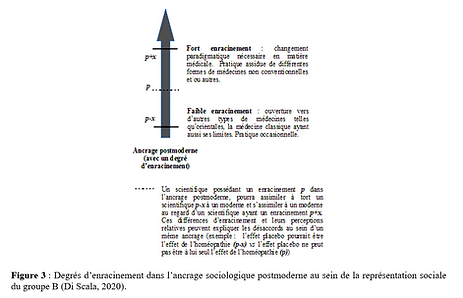
These research analyses, focusing on socially controversial health issues such as homeopathy and vaccination, have highlighted that health-society representations are opposed in terms of the center of gravity of their core. For one group, this center of gravity points to the scientific pharmacological norm, while for the opposing group, it points to the value of medicine without side effects that takes better account of the individual. It should be noted that the pharmacological norm has been identified as a scientific, social, and moral norm when applied in a healthcare context. For each representation, a different sociological anchor could be identified: a modern anchor, pointing to the consideration of the benefit/risk balance in society, for the group with the norm as its center of gravity, and a postmodern anchor, pointing to the paradigmatic limits of current medicine and science, for the group with value as its center of gravity. It was important to note that these norms, values, and anchors are present in each opposing group, but are ranked differently.
On the other hand, the rooting of each anchor seemed to be correlated with a scale of values centered on ethics. Modern anchors seemed to have a stronger rooting when the ethic of justice, centered on what is right in matters of care, was higlighted in their representation; while postmodern anchors seemed to have a stronger rooting in connection with an ethic of privileged care, centered on what is important in matters of care. Once again, the two forms of ethics were identified in the two opposing groups, but with a hierarchy that differs. Moreover, other scales of values have been identified in connection with its opposing representations: the mystical and epistemic level. Indeed, the mystical scale of value seems to be associated with modern anchorage, considering controversial objects as mystical, while conversely, postmodern anchors will see these objects as existing knowledge, to be deepened, and to come. The radical opposition between these two registers has been identified sociologically as being at the origine of legal cases. This research work has made it possible to understand that health-society representations are not governed by beliefs, or a lack of information, even if certain beliefs or scientific misunderstandings may exist in the peripheral systems of representations of certain subjects, regardless of their anchoring. The analysis was also able to point out that French institutions seem to have a modern anchor.